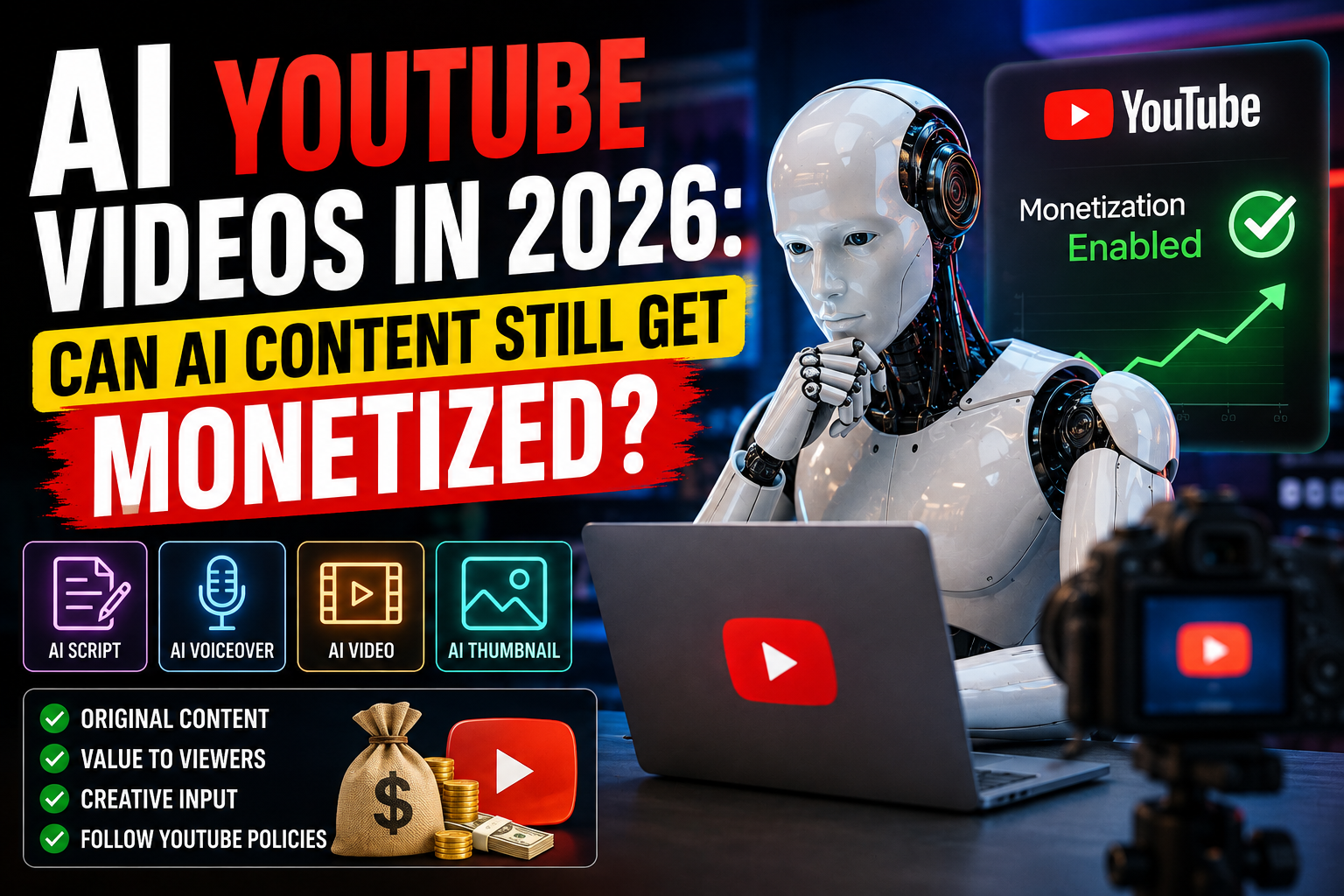
AI YouTube Videos in 2026: Can AI Content Still Get Monetized?
Aug 05, 2026 Launch Tube TeamYouTube
Introduction
A few years ago, creating a YouTube video could take an entire day. You needed a camera. A microphone. Editing software. A thumbnail designer. And sometimes an entire team.
Today, things are very different.
With AI tools, one person can write a script, generate visuals, create a voiceover, edit clips, make a thumbnail, and publish a video without ever turning on a camera.
That's exciting.
But it has also created a new problem.
If everyone can create videos with AI, what happens when YouTube is flooded with them?
And more importantly: Can AI-generated YouTube videos still make money?
The short answer is yes—but there is a big difference between using AI as a creative tool and simply mass-producing low-value videos.
AI Itself Isn't the Problem
There's a common misconception that YouTube doesn't allow AI-generated videos. That's not quite right.
YouTube's monetization policies focus on whether content is original, authentic, and provides value to viewers. YouTube specifically says that content created with automated tools can still be monetizable when the finished work demonstrates the creator's creative input and provides educational or entertainment value.
So using AI to help create your video isn't automatically a problem.
For example, a creator might use AI to:
Brainstorm video ideas
Research topics
Improve a script
Generate background visuals
Create animation
Assist with editing
Design thumbnails
Generate supporting graphics
The important question is: What did you actually create with those tools?
The Real Problem: Mass-Produced Content
This is where creators need to be careful.
Imagine a channel publishing 20 videos every day. Every video uses almost the same script. The same voice. The same visual template. The same storyline. Only the topic changes.
That type of content can quickly become repetitive and interchangeable.
YouTube's current monetization policy specifically addresses mass-produced, repetitive, or generic content. Channels producing content that lacks meaningful variation or original value may not qualify for monetization.
In other words: AI can help you create faster. It shouldn't replace your creativity.
AI + Human Creativity Is the Better Combination
Think about AI as an assistant. Not the entire production team.
For example, you could ask AI to generate ten video ideas. You choose the best one. You research it. You add your own opinion. You rewrite the script. You create a unique presentation. You edit the video. You add examples, stories, humor, or your own perspective.
Now the finished video isn't simply "AI content." It's your content created with the help of AI.
That distinction matters.
What About AI Voices?
AI voiceovers have become extremely popular.
For faceless channels, documentaries, educational videos, storytelling channels, and Shorts, synthetic voices can save creators a tremendous amount of time.
But again, the voice isn't what determines whether the video is valuable.
A fantastic AI voice reading a boring, copied script won't suddenly make the video interesting.
Viewers care about the story. They care about the information. They care about the entertainment. They care about whether the video gives them a reason to keep watching.
Don't Confuse AI With Low Effort
There's a difference between:
"I used AI to create something unique."
and
"I used AI so I didn't have to create anything."
The first approach can be powerful. The second can become a problem.
If you're building a YouTube channel for the long term, don't ask: "How many videos can AI help me produce today?"
Ask: "How can AI help me make better videos?"
That's a much better question.
AI Thumbnails Are Changing YouTube Too
AI isn't only changing video production. It's changing thumbnails as well.
YouTube has recently introduced new thumbnail-related tools, including AI-assisted thumbnail generation in Ask Studio for long-form videos and custom thumbnail support for Shorts for eligible creators.
That's significant because thumbnails are one of the first things viewers see when browsing.
A creator can now experiment with multiple concepts much faster.
But there's a catch. AI can generate a beautiful image. It can't automatically know what will make your specific audience click.
That's still a creative and strategic decision.
AI Videos Still Need Promotion
Here's something that hasn't changed.
Even the most impressive AI-generated video needs viewers.
You can create a stunning video with amazing visuals, perfect narration, and a professionally designed thumbnail.
But if nobody discovers it, the video can still sit there with 50 views.
That's where promotion becomes important.
Promotion isn't a substitute for content. It's a way to increase the chances that your content gets discovered by a relevant audience.
Think of it this way:
Content creates the reason to watch.
Promotion creates the opportunity to discover it.
Both can matter.
Don't Chase Views at Any Cost
AI makes it incredibly easy to produce content. That can be both a blessing and a trap.
You can generate hundreds of video ideas. Hundreds of scripts. Hundreds of thumbnails.
But producing more content doesn't automatically mean growing faster.
If viewers aren't interested, retention is poor, or every video feels identical, uploading even more videos won't necessarily solve the problem.
Sometimes the best growth strategy is simply to make fewer but better videos.
What About AI-Generated Realistic People?
This is another area creators should understand.
YouTube requires creators to disclose certain realistic AI-generated or meaningfully altered content—for example, when AI makes a real person appear to say or do something they didn't actually say or do, alters footage of a real event, or creates a realistic scene that never happened.
The disclosure itself doesn't automatically mean your video cannot earn money.
But failing to disclose required AI alterations can create problems, particularly if it becomes a repeated behavior.
So if you're using realistic AI, don't treat disclosure as something to hide. Transparency is becoming part of responsible AI content creation.
The Future Belongs to Creators Who Use AI Well
AI isn't going away.
In fact, YouTube itself is adding more AI-powered tools for creators and viewers. Recent updates include AI-assisted creation and new ways for viewers to search and discover videos.
The creators who benefit most won't necessarily be the ones who generate the most content.
They'll be the ones who know how to combine:
AI + Creativity + Strategy + Audience Understanding
That's the real opportunity.
AI can help you save hours. It can help a small creator compete with larger channels. It can help turn an idea into a finished video much faster.
But the creator still needs to provide the thing AI can't automatically manufacture: A reason for someone to care.
Conclusion
If you're thinking about starting an AI YouTube channel in 2026, don't be scared away by the word "AI."
Using AI isn't automatically going to kill your monetization.
But relying on generic, repetitive, mass-produced content is a very different story.
Use AI to improve your workflow. Use it to experiment. Use it to make production affordable. Use it to bring ideas to life.
But keep your own creativity at the center of the channel.
Because when AI makes video production easier for everyone, originality becomes even more valuable.
And ultimately, that's what viewers are looking for—not whether a video was made by AI.
They want to know: "Was this worth my time?"
Key Takeaways
AI is a tool, not a replacement for creativity
Mass-produced content may not qualify for monetization
Combining AI with human input creates the best results
Disclose AI-generated realistic content when required
Promotion is still essential for visibility
Originality becomes more valuable as AI content increases
Ready to grow your YouTube channel with real engagement?
At Launch Tube, we help creators get real views, subscribers, and engagement from genuine audiences. Our campaigns are 100% safe and designed to help you grow sustainably.
Q: Can I monetize AI-generated YouTube videos?
A: Yes, if the content is original, provides value, and demonstrates creative input. Mass-produced, repetitive content may not qualify.
Q: Do I need to disclose AI content on YouTube?
A: You must disclose realistic AI-generated or meaningfully altered content, such as making a real person say something they didn't.
Q: Is it safe to use AI voices on YouTube?
A: Yes, AI voices are widely used and accepted. The value comes from the content itself, not the voice.
Q: Can I use AI to create thumbnails?
A: Yes, YouTube offers AI tools for thumbnails. The key is understanding what makes your audience click.
Q: Should I promote my AI-generated videos?
A: Yes. Even great videos need visibility. Promotion helps your content get discovered by a relevant audience.
About the Author
This guide was created by the Launch Tube team. We help creators and influencers grow their social media presence through safe, effective campaigns.
Additional Resources
Read more articles on our blog
Explore our YouTube growth services
Contact our support team 24/7
Let's Connect
Follow us for more social media tips and updates:
[Social media links]
Found this guide helpful? Please share it with your fellow creators!